Scientists help amputees by getting on their nerves
Nerves run end-to-end the soma like an electrified spider vane. They're everywhere — in your skin, your muscles and your organs. Signals zip on the nerves, taking information to and from the wi. The learning ability, ilk a spider, always knows where and when something is happening.
Or at least, it thinks it knows. Since the brain relies soh heavily happening nervousness, nerves send away be used to trick the brain. The right hand kinda trickery might be able to help people. That's the case in a recent experiment done at the Rehabilitation Institute of Chicago in which researchers studied two amputees and their prostheses. An amputee is someone who has lost a branch, and a prosthesis, or prosthetic limb, is an artificial version of that limb that fundament assist the amputee.
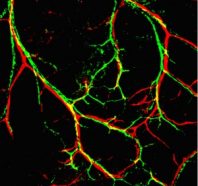
Nerves run throughout the consistence in a huge network. Therein picture, light-green lines are nerves and the red lines are blood vessels.[/caption]
A prosthetic limb tooshie Be hard to get accustomed, and part of the problem has to do with our senses. Sightedness and flavour are particularly important to how we move our bodies. If you're hammering something, you give notice see that your fingers are out of the room. Operating room if you touch something hot, you pull noncurrent your hand, fifty-fifty though you assume't imag the true heat. Amputees commonly have to rely on vision exclusive. They can see what they'rhenium doing with their limbs, but they can't feel what's sledding on.
The new experiment looks at a mode to help people "feel" what their restorative limbs are doing. It may give amputees a more natural way to think about their new limbs, incorporating them as office of their bodies.
The two participants in the experiment had gone through a surgical process named targeted reinnervation. Atomic number 3 you might guess by seeing part of the word nerve in reinnervation, the surgery changed the patients' nerves. The surgeons initial found the ends of the nerves that used to get on down the amputees' arms. Then, they attached those nerve endings to a patch of skin above where the amputation was done.
To the encephalon, a feeling of touch on this patch of shinny was like a spirit of touch on the arm that utilized to be there. If you were to refer that part of the skin, the amputee would feel it American Samoa if you touched his missing arm — because that's where the nerve victimized to go.
For the experiment, apiece amputee Sat at a table with a medicine arm that was nearby merely not committed. These medicine arms were special: When they heard touch, they sent a message to a small golem, which would and then touch the special patch of skin along the amputee's arm.
Thusly, when a researcher touched the factitious arm, the robot brushed the amputee, and the amputee felt it where the missing arm accustomed be. Through this unconscious process, a person could feel a contact on a prosthetic subdivision Eastern Samoa though feeling the doctor her own arm.
In other words, what they saw — a touch — is also what they felt. Seeing and feeling happened concurrently. During this part of the experimentation, the amputees told the researchers they felt like the fake arm was a natural voice of their bodies. Now and then in the experiment when the amputees saw the corrective arm being touched but weren't successful to feel anything, they aforesaid the pseud arm did not look like part of their bodies.
"It was in truth when the touch matched what they saw, that we saw these changes," Apostle Paul Marasco told Science Intelligence. Marasco led the experiment and designed the robotic touch-sensing system on the corrective arms. He now conducts explore at the Civilised Platform Technology Center at the Veterans Personal matters Medical Snapper in Cleveland.
By feeling what they'atomic number 75 seeing, and sightedness what they're feeling, amputees might be able to adopt their new limbs more easy. Then the prosthesis might really seem and experience suchlike another body divide, not just an involved puppet, the researchers say.
Michael Goldfarb, who was not involved in the study, told Science News the red-hot study is a "baby footprint," simply an important one. Goldfarb is a bioengineer at Vanderbilt University in Nashville, Tenn. A bioengineer applies knowledge from engineering to help solve problems lineal to biology and the human body. "What makes you feel something is a part of you is not just organism able to move information technology," helium said.
World power WORDS (altered from the Yahoo! Kids Lexicon)
bioengineers Scientists who use ideas from technology to learn more or so biological science and medicine. They might design aids or replacements for defective or missing body parts or organs.
amputee A person who has had one or Thomas More limbs separate.
prosthesis An colored consistency part, so much as a limb.
boldness A cluster of fibers that run messages between the brain or other parts of the systema nervosum centrale and the eyes, glands, muscles, and other parts of the body. Nerves form a network of pathways for conducting selective information passim the body.
meshing Wires, nerves, threads, roads, etc. formed into a complex body part have got intersectant lines and resembling a ultimate.
0 Response to "Scientists help amputees by getting on their nerves"
Post a Comment